Run your AI coding agents as one coordinated team.
An open-source MCP server that connects Claude Code, Codex CLI, Gemini CLI, Goose, and more into a single autonomous mesh. Local-first. No cloud. No telemetry.
$ npx claudelink init --all --globalThe problem
One agent is fast. A team is a different category.
Five agents that own slices of the work, talk to each other, review, and retry beat any single session. The blocker was always the human typing “check messages” into every terminal. ClaudeLink removes that human.
Without ClaudeLink
With ClaudeLink
Without ClaudeLink: One agent per task
With ClaudeLink: A coordinated swarm: reviewer, developer, tester, ops
Without ClaudeLink: One model per task
With ClaudeLink: Mix Claude, Codex, Gemini, and Goose freely on the same mesh
Without ClaudeLink: You shuttle messages by hand
With ClaudeLink: Agents message each other directly
Without ClaudeLink: You poll every terminal for updates
With ClaudeLink: Auto-nudge wakes the right agent at the right time
Without ClaudeLink: No single view of the work
With ClaudeLink: Live Command Center at 127.0.0.1:7878
Without ClaudeLink: Every session is amnesiac to the others
With ClaudeLink: Shared SQLite mesh and a persistent bulletin board
How autonomy works
The loop that runs without you
No forged tool calls, no injected prompts, no unsafe shortcuts. A simulated keystroke routes through the agent's normal trusted-input pipeline, which is exactly why it works identically for Claude Code, Codex, Gemini, and Goose.
A message lands
Agent A calls send(). The message is a row in a local SQLite database, unread.
The scheduler notices
Every few minutes the auto-nudge scheduler queries for agents with unread mail. Only terminals that actually have mail get woken.
A keystroke, not an API call
ClaudeLink types "check for updates" into the right terminal, through tmux or iTerm2, exactly as you would.
The agent acts on its own
The receiving agent reads its inbox with its own tools, decides, and replies. The loop continues without you.
Command Center
A live console for the whole mesh
A local web UI at 127.0.0.1:7878. It boots with the first agent, survives restarts, and auto-refreshes every two seconds. Nothing about it leaves your machine.
Registered agents
Every agent with role, status, sent and received counts, last-seen, and a per-agent auto-reply toggle.
Auto-nudge control
Global on and off plus the tick interval. The scheduler only fires for terminals that actually have unread mail.
Health
Unread counts, bulletin entries, orphan blockers, and a one-click heal for dead-agent rows.
Recovery Watcher
Detects API rate-limit and overload errors in agent terminals and types a recovery prompt automatically.
Fleet live context
Per-agent context occupancy, cost per turn, and handoff freshness, sorted most-urgent-first.
Recent messages
A live feed of the last messages across all agents, with priority and unread badges.
Fleet live context · v1.5.0
See every context window. Compact with consent.
Long-running agents silently fill their context windows, and an uncontrolled auto-compact can wipe hours of in-flight work. ClaudeLink shows the whole fleet's occupancy live: percentage bars, cost per turn, handoff freshness, sorted most-urgent-first.
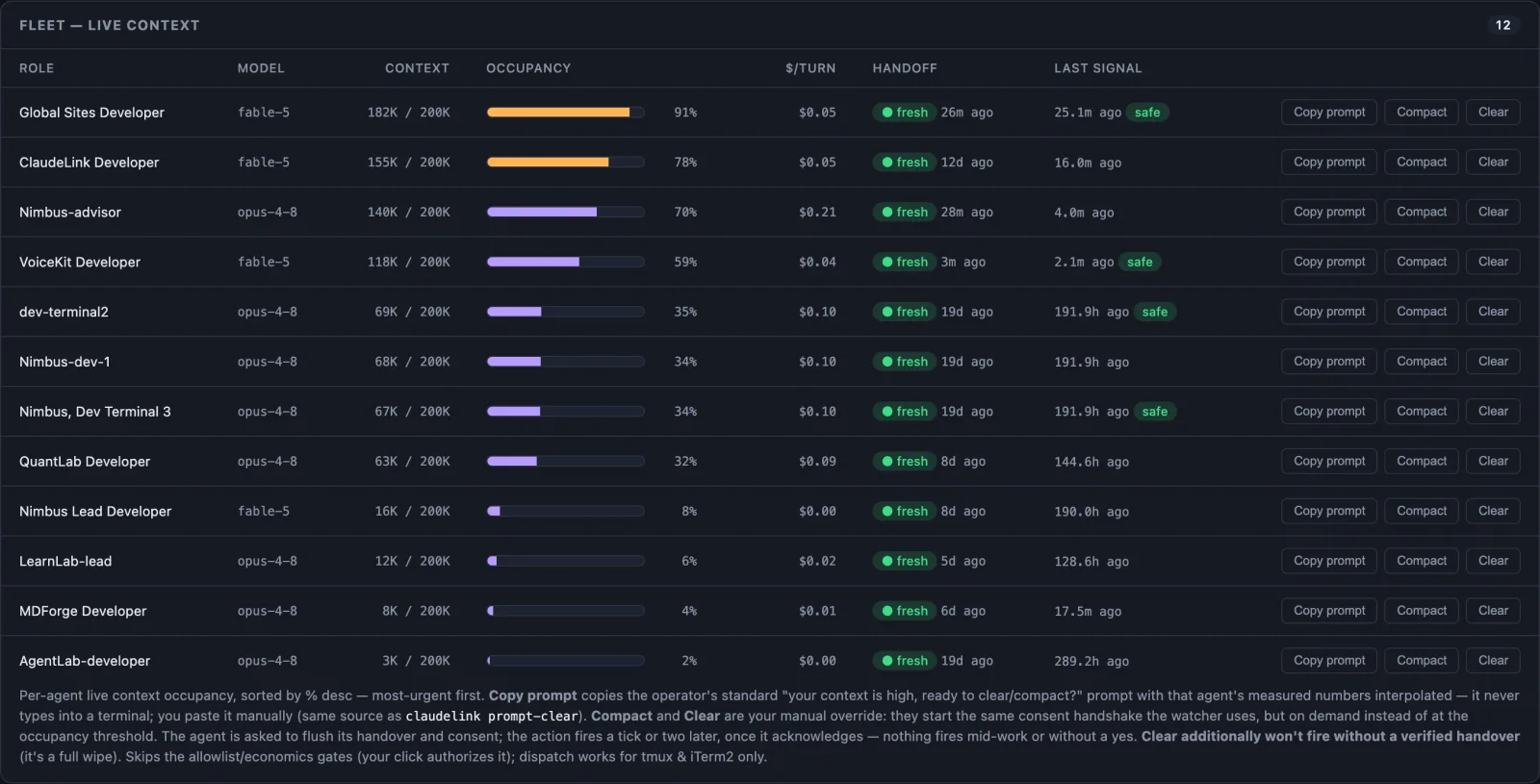
A consent handshake, not a kill switch
Nothing fires blind. ClaudeLink first asks the agent to flush its handover and signal a checkpoint; only when the agent genuinely consents, and is re-confirmed idle, does the compact fire. Clear additionally refuses to run without a verified handoff. Nothing fires mid-work, and nothing fires without a yes.
Plan Usage · v1.6.0
Your subscription's real limits, as live meters
The five-hour session window, the weekly pool, and the frontier-model weekly pool, each with a reset countdown. Opt-in and local-only: a passthrough proxy reads the rate-limit headers your CLI already receives. Your token is never read and never logged.

Fleet Token Meter
The number that explains the whole idea
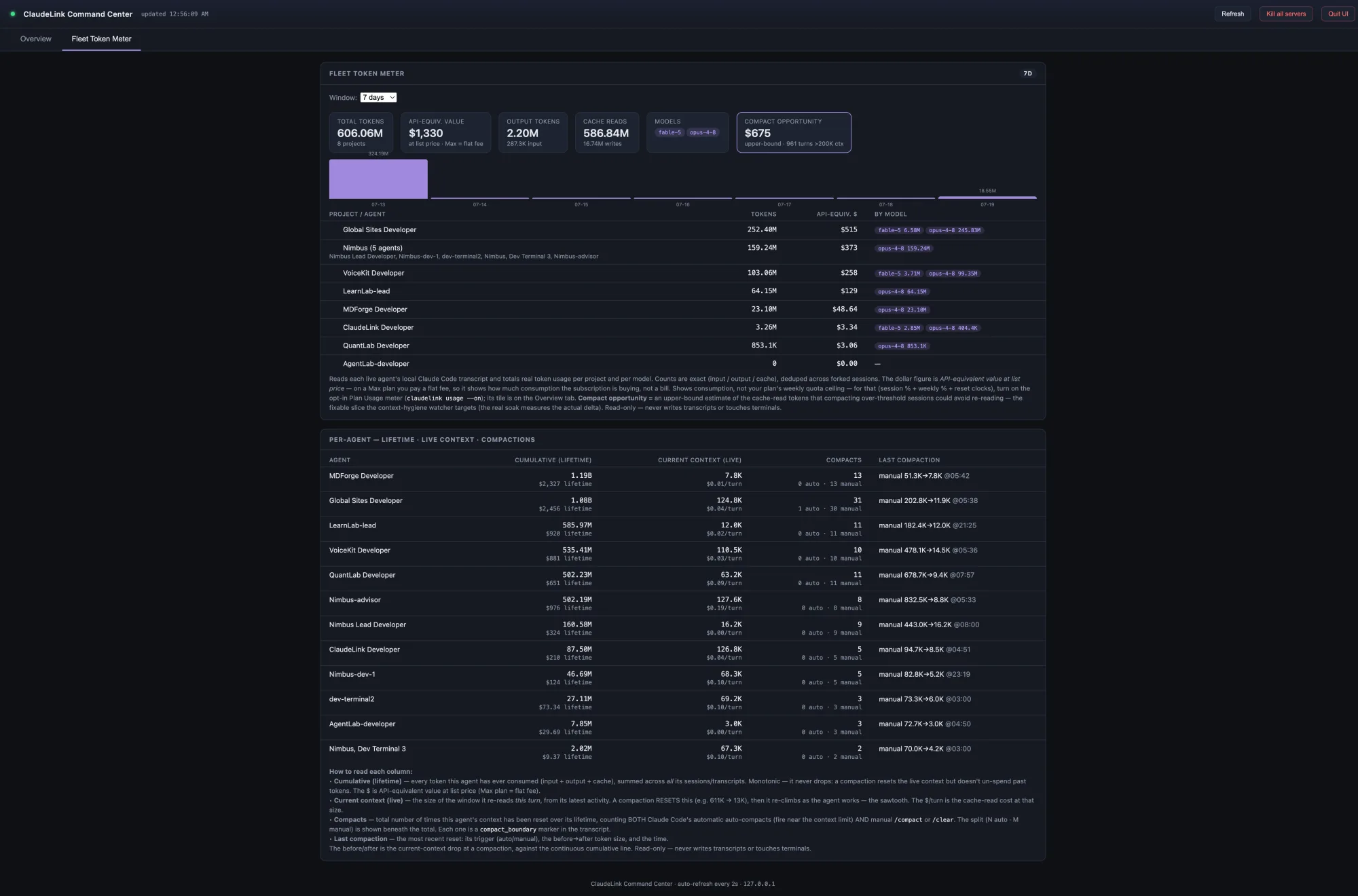
Consumption visibility for the entire fleet: lifetime tokens per agent, compaction history, and what that usage would have cost at API rates.
0M
tokens in one week
$0
API-equivalent value
0
agents on one mesh
One operator's fleet, one week: 606 million tokens, worth $1,330 at API rates, on a flat-fee subscription. The meter is how you know.
Recovery Watcher · v1.4.0
Come back Monday to a fleet that never stopped
When the API rate-limits or overloads, a CLI halts mid-turn and waits for a human. The watcher spots the error in the terminal and types the recovery prompt for you, with cooldowns and an escalation threshold so it never spams a genuinely down API.
API Error: Server is temporarily limiting requests · Rate limited
[recovery-watcher] error detected · typing recovery prompt
› check messages and continue with your current assignment
✓ agent resumed
Any model, any provider
The name says Claude. The mesh does not care.
Four CLIs are first-class with one-command install, and a single Goose terminal reaches 25+ providers. Pick the model for the job, per agent, with no ClaudeLink-side configuration.
Claude Code
Claude Opus, Sonnet, Haiku
Codex CLI
GPT-5 family
Gemini CLI
Gemini Pro and Flash
Goose
25+ providers
One real recipe: a Claude reviewer for hard reasoning, a Codex developer, a Gemini tester, and a local Llama scaffolder via Ollama, all sharing the same SQLite mesh. The full provider list →
Patterns
What operators actually run
Code review pipeline
A developer agent writes, a reviewer agent critiques, and the loop runs until the diff is clean.
Test-driven loop
A tester agent writes failing tests; a developer agent makes them pass; neither waits for you.
Full team simulation
Architect, developers, reviewer, and ops roles on one mesh, coordinated by messages.
Parallel feature work
Several agents on the same codebase, each owning a slice, with a bulletin board for decisions.
Research swarm
Fan a question out to multiple agents on different models and let them compare notes.
Local-first
Built for people who read the source
Runs entirely on your machine; no cloud component exists
No telemetry, no analytics, no phone-home of any kind
No account, no sign-up, no API key of its own
All state is one SQLite file you can open and read
MIT licensed; every line is public and auditable
Agents keep full agency: ClaudeLink never forges a tool call
The details live on the features page and in the docs.
Get started
Three steps, then it runs itself
1Install and configure every CLI at once
$ npx claudelink init --all --global2Restart your terminals
3Open the Command Center
$ claudelink ui
Why I built this
I build software with a lot of AI coding agents running at once. ClaudeLink is the tool I made so they work as one coordinated team, and I open-sourced it so other builders can have it too.
Read the storyIf this is useful, star the repo. It is how open-source tools get found.